
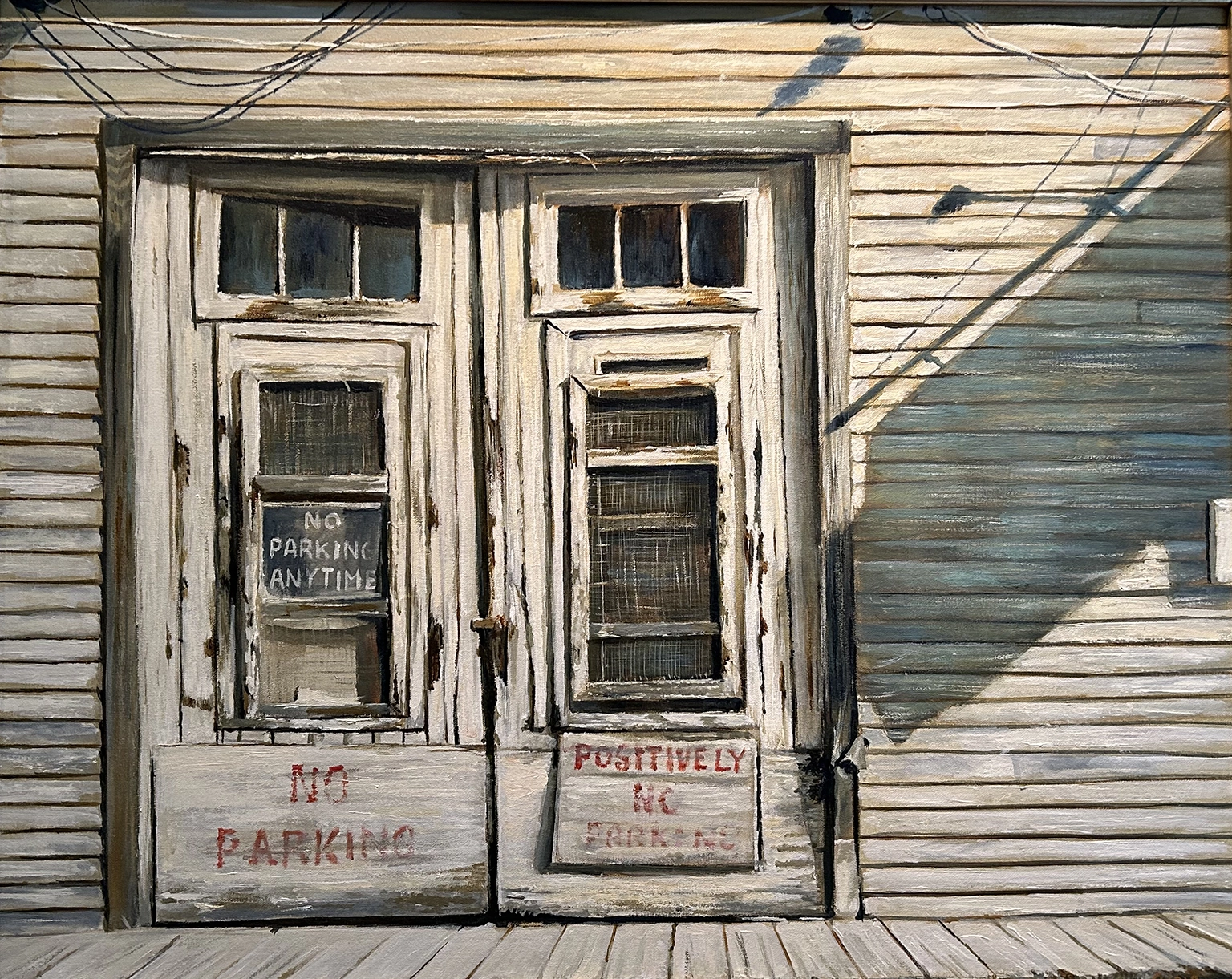
DO NOT PARK HERE
30 x 36, acrylic on canvas
$4000
This Dean Gioia urban realism painting delivers a dry, deadpan wit wrapped in masterful brushwork. “Do Not Park Here” zeros in on a pair of battered double doors set into a white clapboard building — their peeling paint, darkened glass, and sagging frames telling the story of decades of neglect. Three separate no-parking warnings crowd the scene: a hand-lettered sign propped in a window reading “No Parking Anytime,” a stenciled “No Parking” board leaning at the left door, and a bold “Positively No Parking” plank at the right. The redundancy is the joke — and the point.
Gioia renders the composition in a cool, muted palette of chalky whites, weathered grays, and soft blue shadows, punctuated by the faded red stenciling of the signs. A raking diagonal shadow cuts across the right side of the building, suggesting late-afternoon light and lending the otherwise flat facade a quiet drama. Utility lines trace across the upper corners, grounding the scene in the unglamorous fabric of American vernacular architecture.
What elevates this Dean Gioia urban realism painting beyond a simple architectural study is its humor and humanity. The obsessive insistence of the signage — each redundant warning more emphatic than the last — speaks to a very human frustration, rendered with warm affection rather than cynicism. It’s the kind of overlooked corner of a city or small town that most people walk past without a second glance. Gioia stops, looks closely, and finds something worth preserving.
Acrylic on canvas, 30 x 36 inches, ships ready to hang in a frame. A distinctive work for collectors drawn to American scene painting, narrative realism, and the quietly comic poetry of everyday life.
Nostalgic Americana Collection
Dean Gioia’s original acrylic paintings on canvas masterfully capture the fading charm of rural Southern roadways and vintage establishments. His distinctive play of light and shadow transforms ordinary roadside scenes into poignant visual narratives. The atmospheric skies, weathered structures, and distinctive signage evoke a powerful sense of place and time—preserving disappearing landmarks of the American South with ethereal luminosity and emotional resonance that has become his artistic signature.